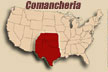
Ca. March 13-14 1846; Paint Rock, Texas: In February and March 1846, Comanches swept down off the Edwards Plateau and raided southwest of San Antonio, hitting the new settlements near Castroville and Quihi. In response, Maj. Jack Hays led forty Texas Rangers from their Medina River camp to go after the raiders. The trail led north through Bandera Pass; at Enchanted Rock, in Llano County, the rangers found a fresh trail going northwest. Hays figured the Indians were headed for Paint Rock, a favorite campsite and watering place nearly 100 miles away. He abandoned the meandering trail and, playing his hunch, headed straight for Paint Rock.
Hays stopped to rest his men at midnight, and the next day he drove them almost continuously. At one o'clock in the morning, the rangers arrived near Paint Rock, where Hays concealed his men in a willow grove not far from the small lake. At dawn, the Indians unsuspectingly passed by. At Hays command, the rangers blasted them with a volley. In the poor light, however, they hit only a few Indians, while more rode up. The Texans were badly outnumbered, perhaps fifteen to one. As the Comanches attacked from the northeast, Hays advised his men to "pick a warrior facing you and aim carefully!" One young recruit, F. W. Harrison, was nervous, and the old hands tried to calm him with jokes, such as "[Those] Injuns look too pretty to shoot." There appeared to be nearly 600 Comanches around them. Harrison remembered, "I saw the long line of painted savages coming and felt the hair rise on my head."
When the Indians were within fifty yards, the rangers fired, knocking many down. The charge split in two. The Comanches regrouped and charged from the west, with the same result. They couldn't break into the willow thicket to dislodge the Texans. The Indians kept up the fight all day, attacking from different directions. Because the lake was within range of the rangers' weapons, the Comanches couldn't get to the water, so many eventually left to find another source.
The next morning, the Comanches attacked from all sides, trying to smash their way into the thicket, but the Texans forced them to break and retreat in the very first wave. Their next strategy was to shoot long-range arrows from the top of Paint Rock, but this tactic, too, was ineffective. By the third day, the Indians had realized they faced the hated "Devil Jack" Hays, and they began taunting him to come out and fight.
After a while a chief rode in close to the thicket, and when he turned to urge his warriors forward, his thick buffalo-hide shield shifted enough to leave an opening for Hays to squeeze off a good shot. The bullet hit the chief in the side and knocked him over, at which point a ranger leapt on his horse, rode out and lassoed the body, and dragged it back into the willows. This impudent action enraged the Comanches. The Indians made one last charge, but the Texans beat them off again. Finally they fled the area, departing so quickly that six Indians who were herding some stolen horses nearby were left behind, unaware that the fight was over. They were still waiting for their tribesmen when the rangers caught them and killed them, recovering about fifty horses.
The exhausted rangers picked up a few souvenirs from the battlefield and hurried back to San Antonio. The Texans had counted nearly a hundred dead Comanches on the ground. Of the rangers, only Emory Gibbons was wounded in the arm by an arrow.